Blogs

NCAA Gets British Education System Wrong

January 28, 2012 15:52 pm 34 comments

NCAA Eligibility Rules for British Basketball Players

There may be no-one in the country better equipped to talk about the NCAA and their eligibility rules for British players than Duco van Oostrum. After his son Nigel (who currently attends NCAA Division 2 school Franklin Pierce) fell victim to the same rules a few years ago, Duco has spent years reading and researching about the NCAA’s stance on British ballers and in this guest blog asks the question why nothing is being done about it.

NCAA gets British education system wrong: Flurry of bizarre eligibility situations

By Duco van Oostrum

Anyone following British basketball must have noticed that a few of the Brits going state-side have run into trouble with NCAA eligibility. When you read of NCAA ineligibility, you automatically assume the athlete must have done something wrong for which they were punished. In these cases, however, the crime appears to be British education and British ‘high school’ students graduating too soon.

According to the NCAA, American high school graduation happens at the moment a British student takes GCSE exams, at age 16. This is the moment, following the logic of the NCAA, a British student could enrol at University and should enrol at an American University if they want to take up an athletic scholarship.

The point appears to be arbitrary and works only because it works for the Americans—it’s a moment in the British education system where everyone does the same. It doesn’t matter that it is false in terms of degree status (try enrolling at Harvard with GCSEs only) or age (ready for Uni at 16?); it doesn’t matter that at 16 it’s pretty impossible to get an athletic scholarship because the body isn’t developed; what matters is that it’s convenient for the NCAA.

The NCAA itself recognises that British education is a problem. After GCSEs, students go on to take AS/A-levels or BTEC. The NCAA, uniquely for Britain, calls this a ‘two-tiered’ education system—a fantastic example of NCAA double-speak. After graduating having taken GCSEs, a student can graduate again, according to the NCAA logic, and again. The phrase they’ve come up with is ‘moving the graduation date.’

Huh? So a student takes GCSEs, graduates and then takes AS-levels (you only have to take 2 for this to work by the way and all you need to do is get an E). The result: the student has now ‘moved’ the graduation date by one year—essentially graduating again. And then the student can do the same with A-levels (so move another year).

For BTEC, the same absurd NCAA logic applies. Only thing is, they don’t then recognize the UCAS system points for equating BTEC degrees (National Award, National Certificate, National Diploma) as equivalent to the AS/A level system, somehow devising one arbitrarily themselves, giving nothing, a year, or whatever they seem to devise at that particular moment.

The government publishes a UCAS points system in the UK in which all post-GCSE education is equated by giving ‘points.’ This is to help the student, the parent, and University admission, and these points are legally binding. You would think that that were mighty convenient for the NCAA. But no, they ignore the UK’s own education system. So not only does the NCAA mistakenly set the graduation date at 16, they then come up with their own post-GCSE education explanation flying against all legal UCAS points systems.

And here is the one that complicates everything: a US high school diploma does not move the graduation date since it is supposedly the same as the GCSEs. A 16-year old student, having done GCSEs, goes to the US to acclimatise to the American education system and gain an American degree. According to the NCAA, this is not advanced education but an attempt at ‘delaying enrolment’ (more NCAA speak), thus gaining unfair athletic advantage over American high school kids.

Think about the logic of this. A 16-year old is gaining academic advantage over US peers by enrolling in US prep school and having to meet its academic requirements? Tell this to the students who have enrolled at US prep schools and who are struggling with their academics, meeting all the pre-college requirements, and prepping for the SAT; the prep schools actually make them repeat a year to help them with the academic transition.

No, says the NCAA, you are not in education since you got all that education at GCSEs. It doesn’t matter that you can prove that to be utter nonsense. The NCAA knows best. For those Americans ready to send their child to a top prep school like Blair and pay the $50,000-a-year tuition bill, you’re wasting your money. Instead, go to a secondary school in the UK (probably for free) and get your GCSEs, finish at 16, and go to Harvard.

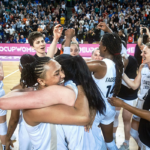
Temi Fagbenle HarvardYou don’t believe me? Read about the NCAA’s ruling of Temi Fagbenle at Harvard (another great read on this from the NY Times here-Ed). Harvard, of all places! Clearly, Temi went to Harvard for the basketball; clearly Temi could have enrolled at Harvard after her GCSEs at 16 and didn’t need a Blair education?

And it’s just the British educated who suffer. The European system is completely different and no one there, according to the NCAA, graduates at 16. It’s the British education system. In Britain, we start primary school aged 5, most other national education systems start at 6. This head-start is one of the reasons for the unique British situation. And, according to the NCAA, that’s a crime worth punishing.

The ‘delayed enrolment’ rule is new to the NCAA this year in Division 1. Previously, it was a matter of having graduated and not being 21 yet when you enrolled. But there’s good news as well. The NCAA has recognised that this rule causes trouble and has added a mysterious ‘grace year’ after graduation—otherwise Temi would have only 2 years of eligibility.

But of course that’s not then applied to previous cases in D2, no matter how unfair those were and are — this is the NCAA logic again: “yes, we know it’s unfair and we’ve changed the rule a bit but it’s just unlucky for those who are still being punished for something which is no longer a crime”; can you imagine this logic in justice?

And then there’s the NCAA own application of its rules. It’s a matter of luck. Yes. You read this correctly. It depends who looks at the application. If you look at the Brits on the NCAA scene, you will find the inconsistencies in the application everywhere. Why did this person sail through eligibility and this one, who ‘delayed’ less, get slapped with a punishment? For those in the know, it’s incredibly easy to put names to these cases.

The British case is not just unique for basketball. The situation is true for all sports. All sports could work together to help their athletes chase their dreams and have put their cases to the NCAA and ultimately challenge them in court.

Why is nothing done about this?

Image Credit: Robert L. Ruffins

Follow Us

Join the 8000+ others who follow Hoopsfix and subscribe.

Please select a site

{ 31 comments… read them below or add one }

orlan jackman January 28, 2012 at 5:46 pm

This is what happened to me… I got my GCSEs then went for my senior year of high school & got years taken away! The counted my senior year of high school as year of college on top of a gap year I took & my two years at junior college

Reply

Mantas Drungys January 28, 2012 at 6:15 pm

Great article! They burned me the same way…
Same as Orlan, I got my GCSEs, then went to my senior year of high school & they took my eligibility away.

Reply

Kofi Josephs January 28, 2012 at 8:16 pm

same thing happened to me aswell lol…..Definetly some funny business..

all we gona see on here is players that have been screwed over

Reply

Roy January 28, 2012 at 10:42 pm

Whenever there is a committee with a large number of members it is always difficult to get “rule” changes made and in the case of the NCAA, it is no different as it has quite a substantial Executive Committee.

As Gary Williams (ex Maryland coach) suggests, maybe there should be an NCAA basketball commisioner since there is no one on the Executive Committee who is intimately involved with basketball, although of course the present rules govern all NCAA sports not just basketball.

Maybe if strong representations were made by our own EB to the Chair of the Executive, Ed Ray and/or to Mark Emmert, the NCAA president , perhaps it might be possible to change the present inadequate (and nonsensical) rules re British “graduation”.

Do other UK sports suffer the same problem? If so, can not some form of joint approach be made to the NCAA?

We can always live in hope

Reply

Matt Roberts January 29, 2012 at 12:28 am

I think taking this matter to Parliament and asking them if they can send a letter of clarification on the British Education System in an attempt to highlight the issue to the NCAA with a bit more clout than EB, who although are the Governing body for basketball, the NCAA doesn’t have separate departments for each sport. Has anyone already tried writing to an MP to ask if they can help? What response did you get?

I’ve seen a number of players over the past 5-6 years have hit-and-misses on their eligibility, I just found it bizarre, as two players with almost identical schooling, one is fine, the other is not, but how? How can two kids with the same schooling have different eligibility? That would suggest to me that the NCAA rules are unclear and the vetting process needs reviewing. It does seem to be pot luck as to whether you get a pass or not, that just should not be.

Something needs to be done to correct the NCAA, has anyone tried pointing out that our kids don’t go straight from high school to University, at age 16? They have to take two more years of education before they are eligible for University. There needs to be some form of British exception rule, to assist the administrators who deal with the processing of applications.

Reply

nobody January 29, 2012 at 7:19 am

As much as you all see this as a problem you have to remember that British Kids have managed to secure places in American University after GCSE, so the NCAA do not have to care.

And the problem explained by Duco van Oostrum (by the way a nice read) is a general problem, so it affects all potential student athletes. I do not remember seeing our swimmers or Football (Soccer) players complaining about the eligibility rules, so basketball can make as much noise as they like but it will not help.

If you read the NCAA rules carefully, to be honest you need to get in translated from American English into English English it explains all the steps to maintain eligibility. As much as I love basketball I believe that the basketball community are getting caught up in the hype of Div 1 scholarships and how easy it will be to get in once you get to the states.

My advice is read your books and study for the SAT or ACT at home and then go to the US. You do not hear of swimmers going to prep school or leaving for a senior year in high school and we have more swimmers on scholarships than Basketball.

Reply

Mantas Drungys January 30, 2012 at 12:08 am

Your last paragraph dont make any sense.
Read books and study for SAT or ACT? In order to submit your eligibility form you need to pass and submit one of those. So we have been doing that… I personally never heard of going to US college without taking either one.
Going to prep school or leaving for senior year in high school is just one way basketball players try go USA to try earn a scholarship. If you stay and go to 2-year UK college and try go to USA college after, you still get burned on eligibility.
The problem with the second way, is that NO ONE is recruiting in UK for basketball. So you HAVE to leave and go prep school or high school to show yourself. Either way you get burned, so i dont understand what you was trying to intent with your last paragraph.

Reply

nobody January 30, 2012 at 12:48 am

This is slightly off topic so I apologise to the article writer.

You do not have to leave the UK to get recruited, they are many kids who have stayed in the UK, stayed on the A’level / BTEC route and have not lost any eligibility going to the states. The point is today the rules are very clear (it was not so clear in the past ) and all the kids wanting to go the US know the rules, it has nothing to do with fairness

If you are really going over to the US to get an education and play basketball then it is in your best interest to get a 4 year deal otherwise you will be left with a big bill in trying to graduate in a limited time.

Not many guys are going to get in the NBA or make a decent living playing basketball after college and this factor seems to get lost on many people.

As for the US senior year of high school and prep school system – I find it a waste of time if you have passed through the UK system because

1. No guarantee of getting a scholarship
2 You will penalised for taking this route

I

Reply

Duco van Oostrum January 30, 2012 at 8:37 am

Had to respond.
‘today the rules are clear’. But what about tomorrow? Rule changes come and go, having disastrous effects on all those caught up in them. The current delayed enrolment rule for D1 came into effect when many of UK kids were at Prep schools, which was OK prior to 2011.
‘today the rules are clear.’ When they went to prep school, that route was absolutely fine and taken by many (almost all) players in D1 (Bryant Amaning, Ben Eaves, Justin Robinson, Luol Deng to name a few, the list goes on). But now they get ‘punished’ because the rules changed while they were on that legitimate route. The rules might be clear (I dispute that) but the application of those rules are all over the place by the NCAA themselves. Again, some get punished (again, not for a crime!) Somehow, the rhetoric implies that someone did something wrong. That is the part that is false. The student had an education and is punished for that. End of discussion.
‘Today the rules are clear.’ Explain it to the compliance officers, the parents, the players, etc. that you graduate at 16 after taking GCSE. The point is not that you could enrol at US University, but that you couldn’t at a UK University. Ironically, the NCAA devalues its own education to such an extent that it equates a Blair Academy degree with GCSEs. Another example of this devaluation is the way the GCSE grades are rewarded–grades go up by a letter grade! So a D in History at GCSE, becomes a C in the NCAA calculation of the GPA. Think about this. A C at Blair in American History equates to a D at GCSE.
These ludicrous ‘rules’ are littered throughout the NCAA world. What is the NCAA? An education institution or a justice department? Many problems stem from the confusion in that role–see the article in NY Times. The schools themselves are afraid of the NCAA and won’t sue, no matter the injustice.
By the way, there are many problems with UK football players going to US college.
Why would you go to US high school for swimming? University I get (full scholarship, etc). Don’t you know about the state of basketball in the UK and the opportunities here to become an elite player between 16-18?
It is easy to devise a pathway to go to the US with the current rules–Kingsley Okoroh is doing AS/A levels while in the US. Players can go for a postgrad year after A-levels or BTEC (BTEC was on the verge of being axed as a way to move the graduation date, by the way–another instance of on the hand the NCAA belittling its own education system and at the same time passing arrogant academic judgement on a UK system). Players can play BBL/EBL div 1 with professionals now, while studying, and still be eligible (another rule change). Yes, ‘today the rules are clear’….

Reply

Lucas Van Nes November 14, 2012 at 6:06 am

hi duco, its lucas van nes. believe it or not. i too am having to go through this ridiculousness with the ncaa. it is something i feel very strongly about and have tried getting through to people higher up in the NCAA. but they are about as hard to reach as the gold at the end of a rainbow. hopefully they will figure out what is wrong with their system. My college coach told me of a player he had come from canada (where they can also finish high schoool at 16). basically these players in canada can finish high school at 16, then go on to do 2 years of college in canada and either have 4 full years of playing time in america or go on to a university in canada. ITS CRAZY! anyways i hope its all going well, best of luck!

Reply

Mike Olson January 29, 2012 at 1:56 pm

I am quite familiar with Duco’s argument and he is spot on. I have been waiting for someone from the UK to challenge this in a lawsuit. The NCAA seems to adjust their rules and interpretations on the fly. I coach in prep school and spend a good deal of time in the UK. I’ve had two players in my program—Jesse Chuku and Jonny Bunyan—who have both felt the incredible injustice of these biased eligibility rules. Jonny should have had two years of eligibilty in the States (he is now back in Scotland and playing for the Rocks). Jesse, as well, should have had two years. He has stayed the extra year because of an illness but will be forced to appeal his fourth year of eligibility while at Lehigh.

UK kids are getting short-changed—someone needs to challege this, and soon!

Reply

Paul Williams January 30, 2012 at 11:07 am

The link provided in the article to the NY Times story by Joe Nocera will take you to the subscription page. You need to know how to breach the subscription wall to reach the article. Find it at

http://www.nytimes.com/2012/01/28/opinion/nocera-et-tu-harvard.html?_r=1&partner=rssnyt&emc=rss

It is not only British, or indeed foreign, athletes who are treated abysmally by the NCAA. This happens more often to Americans, many of whom are prevented from playing even when they have done nothing wrong. Joe Nocera has been conducting a campaign about the abuse of power by the NCAA for several weeks. You might be interested in reading his other articles on this topic. You will find links to his other four articles in the series on the page I link to above, under the heading “Related in Opinion”. There are currently 178 reader responses to these articles that you can view under “Reader’ Comments”.

The NCAA is a law unto itself. Even universities as prestigious as Harvard would not dare criticise its decisions, even when such decisions constitute an egregious abuse of power.

The real elephant in the room however is College Athletics in the USA, which has, through the medium of television, ballooned into a multi billion dollar industry, with top football and basketball coaches on multi million dollar contracts. A situation in which a Nobel prize winning professor is paid just a tiny fraction of the amount doled out to a football coach invites the question: “What is the real purpose of a university?” I’ve spent enough time on my soap box, so I will end with an unexpurgated account of the Harvard University criticism of the disgraceful manner in which the NCAA have dealt with Temi Fagbenle.

Paul W.

Reply

Michael Okoroh January 31, 2012 at 9:19 am

A fascinating contributions from everyone which is a must read for anyone thinking of sending any kid to any US High School for further education and basketball development.

One vital point that has not been covered here though is the reason behind NCAA new eligibility rules which I totally agree is grossly unfair to British kids and might even in some ways hinder the development of our future basketball stars like Luol Deng, Bryant Amaning, Ben Eaves, to name but a few.

One camp behind NCAA new eligibility compliance says it is to cub the influx of foreign players in US which is hindering the development of home grown US basketball players. Where did I hear that before?

Others argue that it is to stop youngsters from some foreign countries who falsify their birth certificates thereby gaining admission into US High School and having unfair advantages over the indigenes. Take your pick.
One thing is certain though, it is going to be extremely difficult for any British kid who has completed either A-level or BETEC studies in the UK before going to the US to make an immediate impact into College Div 1 basketball games.
To be a star in Div 1, College basketball, you need to be game ready before you enter college and one year prep school in US before going to college would not give our British kids (17-18 years) adequate preparation to play ‘hard’ Div 1 College basketball games. Good exposure to college coaches and good support networks are also essential ingredients for success in both college and NBA bb. Agreed that not all our kids will make it to the NBA, but they need to be given a fighting chance. Who wins a lottery without playing?
Due to the current status quo in EB, the manner in which our school system is structured, the limited basketball training and coaching facilities in the country, I would argue that our boys and girls need more than one year in a good US prep school to be game ready for div 1 college basketball. Admittedly, EB is making good progress in this direction but we have a long way to go.

I have tried to compare the UK and the Canadian NCAA eligibility compliance requirements as we seem to have similar education system. It is difficult to fathom the reasons why it is easier for Canadian boys and girls to have more years in US prep schools than British kids without jeopardising their NCAA eligibility compliance.

An alternative path way however, for our kids who had completed their GCSE in UK and want to go to US prep school is to continue with their AS/Alevel and basketball development in US (as pointed out in Duco’s excellent contribution above). Fortunately, (for now) there are currently no restrictions in the NCAA eligibility rules which country you did your A level provided it is completed within 2 years. All that is required is to get a minimum pass in just 2 subjects. The only drawback with this option however, is that in order to be eligible to play High School basketball games, you must also enrol in US High School subjects. It is not easy but doable with good supporting networks. Any British kid who has successfully completed GCSE will cope well with US High School subjects and 2 A-level subjects. Kingsley Okoroh is a living example. There are now many online A-level courses.

I still strongly feel that EB should make strong representation as suggested by ROY to the NCAA and voice out these injustice and unfairness towards British Kids. Waiting for a joint action with other sporting bodies may not be the best way forward as it may be difficult to get consensus. Perhaps, after making representation to NCAA and if nothing came out of it, then, it may be an opportunity to get MPs involved.
MO

Reply

umar February 2, 2012 at 4:24 pm

so what are they trying to say we do if we want to play in the states?

Reply

Smackyoselfukhoopers February 3, 2012 at 2:56 am

Well obviously this author don’t understand the level of competition there is esp through a HS circuit. Only way to do this is go there as a walk on and see if they make the squad at 16 competing against 18 yr old parade all Americans and others more physically and mentally advanced. Let’s get real here. The British high school system in the uk is very applauding compared to the system back here in the states. There’s no way in hell a 16 yr old coming from the UK be a major factor in the college level physically and mentally. Virtually impossible. The British are naturally not physically or mentally tough enough to play at that type level so why should they change the system for English kids to play in college at 16?!?! MAYBE D3 or NAIA cuz the competition is not as high as a mid or high major d1 schools. I can’t even name 5 English kids who play high major D1 schools who are solid contributors. So what makes this author think they got a chance at 16? The NCAA are working in favor for the brits cuz the Brits need to get acclamaited to the high pace up and down game and have a good understanding of the game cuz u just can’t learn that in the UK

Reply

Andy February 3, 2012 at 11:23 am

Wow – get ready for some incoming because you clearly cannot read, write or understand English.
you have completely misunderstood the argument.

Reply

Matt Roberts February 3, 2012 at 12:36 pm

It’s as if you read the title and then wrote your answer.

I think you’ll find Duco knows how the US system works, his son did go to US high school before going on to college.

You’re mistaken when you say the author doesn’t understand the level of competition, I think you’ll find most people involved in British Basketball at National League level is aware of the level of competition in the states.

The point that’s being made is that according to the NCAA, UK kids ‘graduate high school’ at 16, and that this level of EDUCATION is the same as graduating American High School at 18, nothing to do with the standard of basketball being played. Clearly that is not the case, no 16 year old can go to University off GCSEs alone, they need either A Levels or a BTEC or similar. The problem arises when a Brit goes to High School to improve their game before going to college, normally to give themselves a better chance of making it to a decent college and getting minutes, and because they have taken the GCSEs they are classed as having already completed high school, and therefore are gaining an unfair advantage by “re-graduation high school” in America, as the NCAA thinks that GCSEs are equivalent to graduating high school in America at 18, this is not the case.

The point has nothing to do with standard of play, it’s the lack of understanding of how the British Education system works, and that the NCAA needs to correct this to A level being the same as graduating American high school, so that kids can go to high school in America and improve their game whilst taking the classes to graduate without fear of being punished with years knocked off their eligibility because they chose a root that would help them get into a US college and be at a level to compete at that level.

Go read the article again, and maybe this time you’ll see that you’re talking bollocks.

Reply

Roy February 3, 2012 at 1:38 pm

Is it possible that the NCAA decides that, as it is possible to leave school at age 16 in England , that is the age at which a youngster can “graduate”. (although recent changes require some type of education or training until 18 I believe)

Having said that, it is the same I believe in the USA where, in most States, although not all, a person can also leave education at the age of 16. Does this mean the American youngster can also “graduate” at 16?

In a previous comment, the author misses one of the points of the original article. No one is suggesting a 16 year old should or could play in college, but that he or she should be allowed to attend high school or prep school with no set disadvantages against him or her.

Reply

LB February 3, 2012 at 9:37 pm

I THINK THE WHOLE SYSTEM IS CRAP ! Especially when your basketball level is far higher than your education level , Try getting over there when you have a learning dissability. lol .

Reply

Mark Greenwood February 7, 2012 at 2:35 am

The NCAA system really needs to figure out the British system. When I left junior college after only playing one year to go to a NCAA school, the NCAA decided that they wanted to take two years from me and make me sit a year. So i went from being a freshman to a senior. What I dont really understand is, is that its ok for a player to re classify themselves here in the US like Nerlens Noel did but has now decided to re-join his original class. Or its ok for a kid to go to prep school after high school, and then enrolling in college after.
They really need to figure out the whole situation

Reply

P.S February 7, 2012 at 11:42 pm

I finish my GCSEs this summer and I’m planning to go Prep from September 2012. I’ve read a lot on this but still don’t get it. Will they take a year from me away or not?

What about NAIA? Is it as bad as it is with NCAA?

Reply

Duco van Oostrum February 10, 2012 at 12:20 pm

Read Michael Okoroh’s reply above. It tells you what to do. If you’re desperate to go to the US and you want to stay eligible for NCAA, continue to do AS/A-level while out there (you need to take 2 subjects). This is then in addition to the academic work the US prep school requires you to do. Make sure they don’t let you ‘repeat’ a year. So enroll as a ‘junior,’ not a sophomore. You can always take a postgrad year if you want to stay an extra year then after completion.
But hey, they might change the rules while you’re out there. It is a risk. If you continue to do your education here and play/practice high level bball, there is a lot less risk.
NAIA don’t have ‘delayed enrollment’ rules. Don’t be surprised to see a lot of British basketball players in that tough league in future.

Reply

LB February 10, 2012 at 3:44 pm

Duco can i ask you a question ? if so would you suggest a player may be better off here ? if so why and if not when would you think may be the right time to go ? Thanks. players parent.

Reply

Duco van Oostrum February 11, 2012 at 10:13 am

LB. Feel free to email me.
This is such a hard question (player better off here or there?) and impossible to answer. There are always worst case scenarios and best case scenarios and I find that most players/parents in this situation only look at the pathway of the best case scenario (prep school, college scholarship at North Carolina, NBA).
The issue has to do what’s on offer here in the UK for players aged 16-18 and whether players will progress. This means look at academies, pro-clubs (is your child good enough to practice/play with a BBL team or EBL D1? It’s OK now to play with professionals as long as the player is not a professional contract), and their record in improving kids–what have players done who ‘graduate’ from that programme? Places with a ‘record’ of placing players, I think, are Barking Abbey, Reading, or (something different) the CBA (Gran Canaria Basketball Academy–not the basketball club that plays in the ACB, by the way, and you would probably have to pay). EB are appointing someone to look at further elite development at this age here in the UK and many people are working very hard to provide a real alternative to the risk-laden US route.
An alternative route to the NCAA that no one seems to talk about: go to a European club between 16-18, pay your own way (a lot less than US prep school!), do the IB or A-levels from there (or the country’s national curriculum), learn the language, etc. The interesting thing is that the IB and similar Euro education models also ‘move’ the graduation date for the NCAA (that’s why the entire GCSE/Euro comparison is so unfair to the Brits–but why not use it as an advantage?). In addition, if things don’t work out for US college, the player can go to Uni in the UK (the IB and similar is rated the same a A-levels) and all options are still open. If you go to US prep school and things don’t work out, you don’t have the qualifications to go to Uni.
We all struggle as parents. There are clear answers. Circumstances are different for everyone and there needs to be an honesty about possible scenarios.
Good luck.

Reply

LB February 11, 2012 at 11:28 am

It would be great to email you .. Thanks..

Reply

Roy February 11, 2012 at 8:52 pm

There is no doubt that the rules and regulations of the NCAA regarding the English education system is a problem for any young player thinking about playing basketball in the United States, but is just one of many facets that should (must?) be considered by the player (and his/her parents) before making a final decision to play basketball in America.

Having sent quite a few players to the States I am only too well aware of the many pitfalls that can befall a player going to America. Of all the players that I sent, only one had any degree of success and was eventually able to play in the NBA and then Europe.

Apart from the obstacles mentioned in the original articleand the associated comments by Duco, just choosing a high school or prep schools is fraught with difficulty. For example, how does the school rate in terms of education and teaching? How will the player fare regarding the different style of teaching and different types of exam (SAT etc.) Where will the player stay? How much will it cost for both the school and for normal living expenses. How will the player adapt to a different culture and life style? Where is the school located, in town or in the suburbs? How will the player get around? Will the player (be able to) mix with other students. What league does the school compete in and how good is the standard? Is the coach interested in the social development of the player and in his education, or is he just interested in how the player contributes to the team?

Once the player finishes at school, what chance has s/he of playing NCAA (or NAIA) in college and at what level? Will the player be educationally qualified to play at a four year college or a two year junior college? Here again, many of the problems that had to be addressed when considering a high school or prep school have to be considered when choosing a college, especially as many coaches tend to be more interested in a player’s basketball ability rather than how he will do educationally.

After (four years ? in) college what happens next? Has the player managed to succeed and do well educationally? Has the player managed to complete college and, if so, has the player obtained a “worthwhile” degree that has meaning in other countries? (What if injuries happen now or later in life and prevent any future in basketball?) .

If the player has achieved a good standard in basketball will s/he be selected to play for a team in Europe? (Given it is a 99% certainty that the player will not play in the NBA).

Assuming a player’s shelf life in basketball finishes in the later thirties (?) and that player is able to be selected to play in Europe after college, will the salary commanded enable the player to save enough to fund life after basketball (another 40/50 years?) If not, as happens very frequently, what next – for a career?

Whilst it is possibly true for relative few players, there is also the possibility of going abroad but to Europe instead of America.

It is possible to go to a club in Spain, when costs would be far less than the US. The player could have the choice of following the English examination route, or opt to take the Spanish baccalaureate and stay eligible for NCAA (the Spanish baccalaureate ‘moves’ the graduation date). In addition of course the player would be learning another language as super additional life skill (could also do the same thing in France, Germany, and Italy (Greece I believe does not permit foreign players in their youth programmes).

I mentioned above about “degree of succes”s and I guess that, in the end, it just comes down to what a player considers “success”. If just getting to America is considered success, or playing four years in college is considered success then all well and good, but I would respectfully suggest that there is far more to success than this.

These are just a very few of the myriad of considerations that have to be thought about before making any final decision. It is all very well to just consider the short term, but surely life demands that a player should fully consider the, very, long term prior to making such an enormous and important decision that will affect his/her entire future.

Duco says in the previous comment in his penultimate sentence, there are clear answers, but I am sure he means that there are no clear answers.

Reply

LB February 11, 2012 at 9:13 pm

Its good to hear every ones thoughts on this .. Its not a easy decision to make ..

Reply

Duco van Oostrum February 11, 2012 at 10:32 pm

You’re absolute right Roy. I meant to say the are NO clear answers.

Reply

Quint Clarke March 8, 2012 at 12:05 am

Duco — Agree that this is an outrage and an unconstitutional infringement on the rights of UK athletes in the US.

I’m a bit confused by your reference to D2. Are the same rules applicable there or is there some adjustment. What about D3?

Thanks.

Reply

Duco van Oostrum March 8, 2012 at 9:17 am

Hi Quint,
D2 had the delayed enrollment rule, before D1 adopted it–but the adaptation of the rule was and is extraordinarily inconsistent. There are differences still in the small print. D3 doesn’t have delayed enrollment rule, but 5-year clock. NAIA no delayed enrollment and you can take time out from your studies, but lots of rules about number of credits and academics.
Rules keep on changing, by the way.

Reply

LB June 21, 2012 at 7:30 pm

All i can say on this subject is you need gcse`s btech`s A levels and any other possible qualification to understand any of the NCAA LOGIC !!! the whole system is WRONG !!!! ive spoken to many American coach`s who arnt sure on this system, so how are the british players and coach`s supposed to get on …ive had nothing but grief trying to help my son get over there…

Reply

Leave a Comment

Be cool. Critical is fine, but if you're rude, we'll delete your stuff.

{ 3 trackbacks }

Previous post:

Next post: